Ketamine for Chronic Pain: What Every Therapist Needs to Know

Dr. Sandy Newes

I have been thinking about the connection between chronic pain and trauma for a long time, mostly because I kept seeing it in my own clinical work. Clients who came to me for ketamine-assisted psychotherapy focused on trauma would, somewhere in the course of our work together, mention almost as an aside that their chronic pain was significantly better. Not gone necessarily, but changed — quieter, more manageable, less all-consuming. And I started to wonder whether what we were doing together in the therapy room was doing something the medical world hadn't fully accounted for yet.
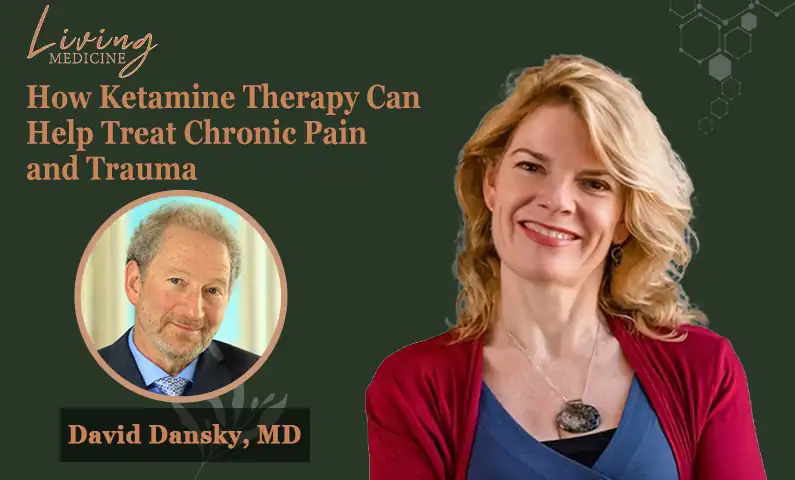
That question brought me into conversation with Dr. David Dansky, an emergency medicine physician who has been working with ketamine since 1990 and now runs an integrative ketamine practice in Carmel, California. David is one of those rare medical practitioners who is genuinely curious about the therapy side of this work — not just the pharmacology, not just the procedure, but what happens in the room and why it matters. Our conversation was wide-ranging and deeply illuminating, and I want to share some of what I learned.
Ketamine Has Always Been a Pain Medicine
One of the things David helped me appreciate more fully is that ketamine's use for pain is not new or experimental — it is what the drug was originally developed for. It has been FDA-approved as an anesthetic since 1970, used in emergency rooms and operating rooms and ICUs for decades. What is relatively new is our understanding of how and why it can work for the kinds of chronic, treatment-resistant pain that have historically been so difficult to address.
The core of it comes down to NMDA receptors and the ascending pain pathways in the nervous system. When pain becomes chronic, the nervous system can get locked into a kind of self-sustaining loop — the nerves keep sending pain signals, the body reacts, and more pain signals follow. Complex pain syndromes like trigeminal neuralgia and complex regional pain syndrome are particularly difficult to treat for exactly this reason. What ketamine appears to do is interrupt that loop by blocking those ascending pain messages, essentially creating enough space in the system that the cycle can be disrupted.
David made a point that I found really clarifying: the question of whether ketamine changes the pain or changes the person's relationship to the pain may actually be a false choice. It seems to do both. He described his own experience with dental pain — having tried everything available and still being in agony — and finally taking a ketamine lozenge and finding that while the pain was still technically present, he was completely dissociated from it. And separately, he described a charley horse that occurred while he was under heavy ketamine, where the pain just didn't register as significant. Two different mechanisms, two different experiences, and both real.
The Link Between Chronic Pain, Trauma, and the Nervous System
What I find most compelling — and most relevant to the work I do as a therapist — is the relationship between trauma, chronic stress, and pain. These are not separate phenomena that happen to sometimes co-occur. They share a nervous system. Hypervigilance, the chronic low-grade alarm state that trauma creates, generates inflammation. Inflammation creates and amplifies pain. Pain generates more hypervigilance. And so it goes.
What I have observed in my own clinical work is that when we do the deep relational, body-based trauma work that is at the heart of ketamine-assisted psychotherapy — when we help someone's nervous system genuinely soften, when they begin to feel safe in their body in a way they may not have felt in years — the pain changes too. Not always, and not always dramatically. But consistently enough that I no longer think of it as coincidental.
David and I kept circling back to a phrase I love, which comes from my colleague Katie Asmus: "It's okay to be okay." Trauma robs people of their ability to feel safe when things are safe. It robs them of the ability to settle into a moment of ease without bracing for what comes next. Part of what ketamine does — part of what the therapy does alongside the medicine — is help people learn that it actually can be safe to feel okay. And when hypervigilance slows, inflammation can slow with it. This is my working hypothesis, and I find it increasingly hard to ignore.
Why the Cost-Benefit Conversation Matters
One of the things I most appreciate about David is his willingness to have an honest cost-benefit conversation about ketamine use, including more frequent and ongoing use for chronic pain. This is not a conversation our field always has easily, because ketamine carries a reputation for misuse and because dependency is a real concern. But David made a point I think is important: we don't ask people to justify taking Advil every day, or oxycodone for severe pain, or SSRIs for years on end — even though all of those carry their own risks and none of them are fully understood over the very long term.
Untreated chronic pain is not a neutral state. It has cognitive effects. It has relational effects. It can cause people to use alcohol daily just to get through. The despair of being in nine-out-of-ten pain with no relief in sight, of having been told by every doctor that nothing more can be done — that itself is a kind of harm. And when ketamine can provide meaningful relief, often with a safety profile that is genuinely quite forgiving in the short term, the calculus deserves to be approached honestly rather than avoided.
That said, David was also direct about what genuine misuse looks like — the patient who drove 50 miles to their appointment while under the influence of ketamine, genuinely believing he was fine. The risks are real and they deserve to be named. The difference between dependency and addiction is a clinically important distinction, and it's one that every provider working with ketamine for chronic pain needs to think carefully about with each individual patient.
What This Means for the Therapy Room
For those of us working on the therapy side of this equation, the conversation with David reinforced something I already believed: the collaboration between prescribers and therapists is not a nice add-on in this work. It is the work. The medicine opens a window. What we do in preparation, in the session itself, and in integration determines how much benefit that window can provide.
David described ketamine as parting the veils — the layers of defense that psychotherapy has always had to work through slowly, often painfully, sometimes over years. With ketamine, things that patients didn't even know were inside them can surface in a single session. That is an enormous opportunity, and it is also an enormous responsibility. The more access people have to these states, the more important it becomes that there are skilled, grounded, trauma-informed people helping them navigate what arises.
I was particularly struck by David's description of a veteran patient — a man who had served in bomb disposal, survived when everyone around him was killed, and spent years afterward in nine-out-of-ten pain despite a spinal cord catheter delivering morphine around the clock. After his first ketamine session, he texted David with a phrase he'd coined himself: "triple zero." No pain, no depression, no PTSD. The stories like this one are why so many of us are here. They are also a reminder of how much is at stake when we do this work without adequate preparation, community, and care.
Practical Notes on Routes of Administration
For clinicians who may be thinking about how to support clients with chronic pain alongside their therapy work, David shared some useful practical information. Topical ketamine cream — typically around 20% ketamine with lidocaine and other supportive compounds — is available through compounding pharmacies and can be prescribed by any provider with Schedule III prescribing authority, not just specialized ketamine practitioners. Intranasal ketamine can provide faster relief and is useful for managing breakthrough pain in specific situations. And sublingual lozenges — which can be swished until pain diminishes and repeated as needed, often at doses as low as 25 to 50 milligrams — offer flexible, titratable relief that people can work into the rhythms of daily life.
The key across all of these is frequency. Chronic pain often requires more frequent administration than we typically use for depression or anxiety, and David made the point that there is nothing inherently alarming about this — it is simply what the condition requires, much as chronic conditions in other areas of medicine require ongoing treatment.
What I Carry Forward
This conversation deepened my conviction that chronic pain, trauma, and mental health are not separate lanes. They run together through the nervous system, through the body's stress response, through the way the brain learns to interpret signals from a world it has been taught is dangerous. Treating any one of them in isolation will always leave something on the table.
The most powerful thing we can offer people who are suffering from both chronic pain and trauma may be exactly what good ketamine-assisted psychotherapy already offers: a genuine softening of the body armor, space to feel safe feeling okay, and the relational container that allows something new to emerge. Not just relief, though relief matters enormously. But a different relationship to the self and to the body — one that doesn't assume pain is always coming, that doesn't brace against every moment of ease.
That, to me, is the deepest form of healing available in this work. And I am grateful to David for helping me understand more of the science behind what I keep watching happen in the room.
Thank you so much for reading and listening! This work is done in community, and I am so grateful for your support.
With care — Dr. Sandy Newes