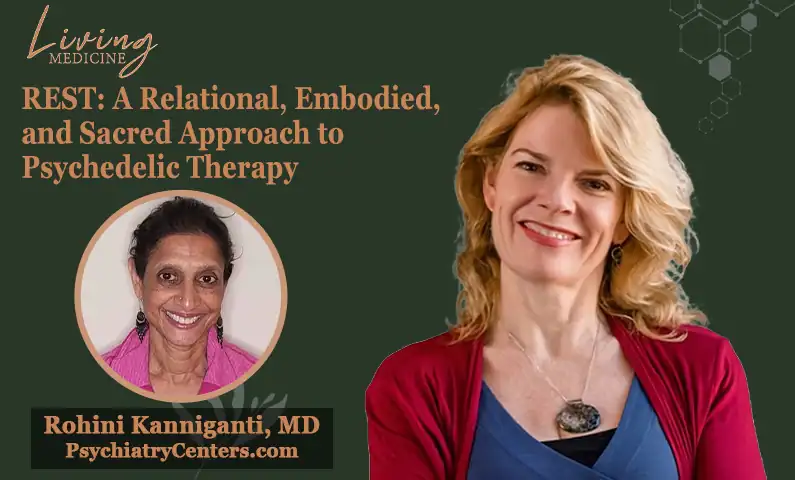
REST: A Relational, Embodied, and Sacred Approach to Psychedelic Therapy

Dr. Sandy Newes

There is a phrase in Dr. Rohini Kanniganti's writing that stopped me when I first read it: the invitation to stop trying to climb out of the human mess and instead trust the soft animal of the body as it masterfully participates in the dance.
That sentence is a pretty good summary of everything Rohini and I talked about in our recent conversation. She is a board-certified family physician, a hospice and palliative care specialist of over a decade, a graduate and faculty member of the Integrative Psychiatry Institute, and someone whose understanding of healing has been shaped equally by Ayurvedic medicine, indigenous scholarship, attachment science, and her own profound experiences with ketamine and psilocybin. Talking with her felt like moving through water — everything flowing into everything else, nothing disconnected.
A Path Shaped by Belonging
Rohini grew up steeped in a Hindu lineage that traces back to the Vedas. Even as a child, she knew that separating the mind from the body was no bueno, as she puts it. At fifteen, she walked out of a thermodynamics class and had a revelation: it's all energy. Why isn't everyone falling over themselves at this?
That early recognition — that what's happening outside is always bridging to something inside — has threaded through everything since. She became a lay counselor as an undergraduate, then moved through public health school, medical school (sustained, she says, by the mantra this is a labor of love, this is a labor of love), and eventually into house call medicine, which became a backdoor into hospice.
The moment she entered hospice work, she says, felt like coming home. She describes hospice workers as rangers protecting the wilderness of the life experience. The limbic resonance in the best of these environments is extraordinary — deeply holy. Her first ketamine journey, received in the context of her own training, confirmed something she already sensed: she'd been here all along. She came out of it laughing.
Healing Through Togetherness, Not Transcendence
One of the most important threads in our conversation was a question Rohini has been sitting with for years: at what point did healing become a solo journey upward, toward transcendence and away from connection? And what did we lose when that happened?
She has been deeply influenced by the work of Tyson Yunkaporta, an Aboriginal Australian scholar who has brought the nonlinear consciousness of indigenous community into an academic Western context for the first time. She recommends not reading his book but listening to him narrate it — because he carries the content in his body, and hearing him can drop you into a non-ordinary state all on its own.
What he names as country — the ecosystem, the landscape, the full community of beings in which we live — points to something Rohini believes we have largely forgotten in the West: that belonging is not a psychological achievement. It is a fact of existence. We belong to the soil, the stones, the mycelium running beneath the forest floor. We are in community with everything. He calls this kinship. And he says we are here to be custodians of it.
This is where Rohini's work diverges from much of what gets called healing. She is not interested in helping people transcend their humanity. She is interested in helping them descend into it — into the body, into relationship, into the warmth and closeness that she believes are both the means and the end of genuine healing.
She wrote something that I keep returning to: true healing does not come from isolating the self to find a quiet individual calm. It comes from increasing the richness and depth of the connections within the ecosystem we already inhabit.
The REST Framework
Out of this understanding emerged REST — a framework and a practice that Rohini received, as she describes it, as a word that arrived with a sense of clarity and rightness.
R — Relational. We are here to be in kinship. This is country. This is closeness. The relational dimension is not an add-on to healing — it is the medium through which healing moves.
E — Embodied. Rohini traces this to her time studying Ayurveda in India, where her teacher offered what she calls an algorithm: when the body is at rest, the mind is calm and alert. Within a calm and alert mind, one can see divinity within oneself and all others. She connects this to HeartMath research, which has documented how coherence in the heart changes the brain. It begins in the heart body, in deep rest.
S — Sacred. Not in a religious sense necessarily, but in the sense that what we are tending to is genuinely holy. The body is holy. The dying person is holy. The grief of a family at a bedside is holy. Sacred is not about elevation — it is about reverence for what is actually present.
T — Tending. This is where the practice lives. All of Rohini's meditations begin with an invitation to slow and soften the body into awareness — of the body, the heart, the sensations, the weather inside. Tending is not fixing or transcending. It is being incredibly tender with what's here. Starting with ourselves, so that we can actually be present with others.
She is clear that self-love in this framework is not self-absorption. The whole point of tending to ourselves is that the heart then radiates outward. Connection to others is the destination, not a byproduct.
Waking Down, Not Up
One of the phrases Rohini uses that I find genuinely useful is waking down. Not waking up — down. Into the body, into embodiment, into the full reality of being a creature on this earth in relationship with other creatures.
She describes leading a meditation in which she had participants take an elevator down into themselves, come out, and sit with whatever weather was happening inside. Then — and this is the part that distinguishes her approach — she had them invite someone they love and trust to sit with them. To feel the closeness. The limbic resonance. The warmth that you simply cannot manufacture alone.
This is not a rejection of mindfulness. Rohini is clear that mindfulness creates the capacity to do no harm — it is the foundation. But it is not the destination. The destination, she says, is mature, secure, connected intimacy. Which feels in the body like closeness, like consistency, like warmth, like safety. Attunement equals safety. This is what we are moving toward.
Ketamine in Palliative Care
The thread that connects all of this to palliative care is total pain — a concept hospice workers use to describe how suffering is never just physical. It is relational, existential, spiritual, and psychological all at once. A person approaching death is not just dealing with a body that is failing. They may be dealing with shame, with demoralization, with the feeling that life has somehow rejected them, that they belong nowhere, that there is nothing left of value in who they are.
Rohini has watched ketamine meet people in those places in ways that nothing else quite reaches. She describes patients with intractable depression entwined with physical pain, where ketamine was the only intervention that brought relief — and those patients died peacefully. Not because the medicine erased their suffering, but because it opened something. A door. A window. A momentary loosening of the defenses that kept them from feeling connected to anything larger than their pain.
She is appropriately careful about the practicalities. Ketamine for depression remains off-label, which creates friction in Medicare-funded hospice settings. She does not recommend home ketamine for this population without a very well-established safety foundation. And she is honest that ketamine's effects are temporary — not a replacement for the deeper relational and somatic work that creates lasting change.
But as an adjunct — held within the principles of REST, offered in the context of an attuned therapeutic relationship, integrated through the body and through connection — she sees real possibility. Boosters once a month. Smaller doses over a few weeks, then a pause. A sacred medicine, held within a sacred container. This is how it becomes something more than symptom relief.
The Veil at the Threshold
Near the end of our conversation, Rohini said something that has stayed with me. She spoke of an indigenous understanding that we are closest to source at birth and as we approach dying. The veil is thin at those thresholds. It is also thin in dreams, in fever, when we have been slowed down by illness or injury or exhaustion. When we soften enough, we begin to perceive from heart intelligence rather than head intelligence. We don't need a psychedelic for this. We just need to slow down.
She also described dying well — and what it looks like when it happens. The glow in the room. George Harrison's wife describing that glow. Steve Jobs's last words: oh wow, oh wow, oh wow. Her own deep interest in who are the people for whom dying is not a crisis. What makes a death peaceful. What decreases fear and increases the sense of going home.
What she has found, unsurprisingly, is that the people who die with the most peace are the ones who have known themselves as belonging — to others, to the earth, to something larger. Who have not spent their lives trying to climb out of the human mess, but have instead been willing to be in it, with others, in all its beauty and difficulty and mess.
Infinite Power Within Us
Rohini closed with a message she said she wants to transmit: we have infinite power within us. Everything we need is right here. But she was careful to add: I'm saying us. Not the individual. We're in this net of togetherness. We're profoundly connected. And it is through that togetherness that we feel the intensity and grandeur and the magnificence of who we are.
I believe that. I have believed it for a long time, even when my work pulled me toward individual frameworks and inward journeys. Rohini's presence in this field — bringing the body, bringing kinship, bringing the sacred into the room — feels like exactly what this moment needs.
With care,
Dr. Sandy Newes
To learn more about Dr. Kanniganti's work:
Email: rohini.kanniganti@cultivatingthebeloved.com