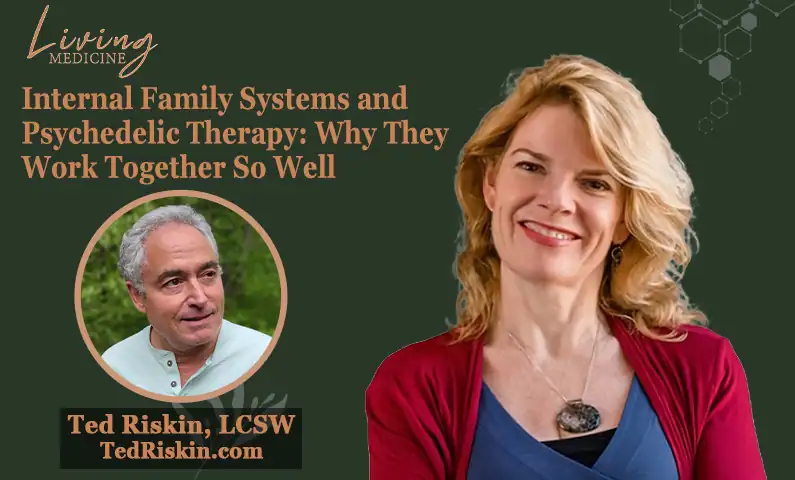
Internal Family Systems and Psychedelic Therapy: Why They Work Together So Well

Dr. Sandy Newes

There is a moment in many psychedelic sessions when the walls come down — when something long-held and deeply guarded rises to the surface. What happens in that moment, and what a person carries away from it, depends enormously on the therapeutic framework surrounding the experience.
That's a central theme of my recent conversation with Ted Riskin, LCSW — a psychotherapist, group KAP pioneer, and one of the most thoughtful voices I know in the intersection of Internal Family Systems and psychedelic-assisted psychotherapy. Ted trained in Holotropic Breathwork under Stan Grof, is certified in IFS at Level Three, and has been running group ketamine programs for five years. Talking with him reminded me of how much depth there is still to mine in this field.
How Ted Found His Way Here
Ted describes his path into this work as one long thread of non-ordinary state exploration. He came to Holotropic Breathwork training through Stan Grof's lineage, was certified in 1998, and found himself drawn to one modality after another — Core Energetics, EMDR, hypnotherapy, breathwork traditions, and eventually IFS. He describes the appeal not as collecting credentials, but as genuinely trying to understand how each approach works, where they converge, and where they diverge.
What drew him most deeply into IFS, he admits, was partly personal. He has a strong mental part — a mind that likes to map, sequence, and think things through. Core Energetics, which asks practitioners to get out of their heads and into their bodies, left him feeling inadequate. IFS gave him a cognitive architecture that he could actually inhabit. It let him bring his strengths to the work rather than constantly struggling against them.
Why IFS Maps So Well Onto Psychedelic Work
I asked Ted what it is about IFS specifically that has made it such a natural companion to psychedelic-assisted psychotherapy. His answer was characteristically grounded: it maps well because it maps well onto people.
He recalled a conversation with Michael Mithoefer, who described watching people on MDMA spontaneously begin talking in parts — without any prompting, without any IFS training. The MDMA, he said, wasn't creating something artificial. It was deprogramming people from the idea that they should be one unified thing. And once that armor came off, the multiplicity of the psyche just showed itself.
Ted's view is straightforward: this is how the psyche is organized. Parts, protectors, exiles, and self-energy — this is the actual architecture. Psychedelics open access to it. IFS provides the map to navigate it once it's visible.
Protectors: The Part We Most Often Misread
One of the most practically useful parts of our conversation was Ted's thinking on protectors — and what actually happens to them during a psychedelic experience.
His view is that psychedelics, almost by design, make it harder for protectors to do their job. Whether through altered breathing patterns that reduce oxygen to the prefrontal cortex, or through the direct neurochemical action of the medicine itself, the mechanisms that keep our defenses operational are temporarily disrupted. For a protector — whose entire sense of purpose is organized around keeping the system safe — this is terrifying.
The clinical implication is significant. If we don't acknowledge what protectors go through during a session, we're likely to see backlash afterward: anxiety, reluctance to return to the work, or difficulty integrating the experience. Ted recommends going back to those parts after a session and simply bearing witness. Acknowledging that something difficult happened. Asking what it was like. Creating space for those parts to feel seen rather than overridden.
He offered a simple but memorable analogy: getting a cat out of a room. You can push the cat, which will not work. You can entice the cat with a treat, which sometimes works. And sometimes, with real care and gentleness, you do have to pick up the cat. The key isn't which approach you use — it's the quality of presence and compassion you bring to it.
Exiles: Where the Healing Actually Lives
If protectors are the part of the IFS model most visible in clinical work, exiles are where Ted believes the deepest healing happens.
Exiles, he explains, are the parts that got split off in childhood because what they were carrying was simply too much. Children don't have the self-energy to contain overwhelming experience — they don't have the container for it. So those parts get pushed out of the system and held in suspension, stuck in whatever moment or age the wounding occurred.
The work of reconnecting with exiles — what IFS calls unburdening — is the heart of the model for Ted. Drawing on Bruce Ecker's work on memory reconsolidation, he describes the mechanism: you go back to where the exile is stuck, you let them show you the traumatic memory in full, and then you create a reparative experience — a genuine mismatch between what the exile expected and what they receive. According to the theory, that mismatch is what allows the trauma memory to actually be rewritten, rather than simply managed.
Psychedelics, he notes, can be powerful catalysts for this process. When someone isn't prepared for an exile to surface, that's often what we call a bad trip. When they are prepared — when there's enough self-energy present to witness the exile without being consumed by it — that same emergence can become a profound healing moment.
Self-Energy: What It Feels Like From the Inside
I've heard a lot of practitioners talk about self-energy in fairly abstract terms. What I appreciate about Ted is how concretely he describes what it actually feels like.
For him, it's somatic first. Calm in the body. Breath that's open and unguarded. A sense of presence without agenda. He checks himself by noticing his breath — if he's holding it, something is going on. A part has come forward and is making its presence known through the body.
He also pushes back gently on the idea that self-energy is an on/off switch. It's a continuum. Parts can carry a great deal of self-energy themselves. What we're working toward isn't some perfectly purified state but rather a gradual expansion of the space that self-energy can occupy — more room for witness, for compassion, for curiosity, for presence.
He said something that I keep turning over: there is no such thing as patience. There are just impatient parts. When they step back, what's left looks like patience — but it was there all along. The same is true for compassion.
The Therapist's Own Parts
One of the threads I most wanted to pull on was the question of therapist self-awareness — specifically, how we as clinicians track our own parts during a session.
Ted is clear that this is one of the most important and most underemphasized dimensions of the work. The part that wants to be helpful. The part that needs the client to like you. The part that is afraid of the client's anger. These don't disappear just because we're trained. They show up in every session.
His recommendation is both simple and demanding: know your exiles. If you notice you're fawning with a client, trace that back. What is the fawning part afraid would happen if it stopped? And what is the exile underneath that fear — the memory of someone's rage, the experience of being abandoned, the wound that taught you that your value depends on whether other people are pleased with you?
He recommends Kylea Taylor's book The Ethics of Caring — revised for the psychedelic context — as a practical map of the exiles most likely to show up in practitioners: the need for love, approval, money, specialness. Getting to know those parts in advance isn't weakness. It's the foundation of genuine presence.
Why Group KAP Is Its Own Kind of Medicine
Ted has been running group ketamine programs for five years, and the affection in his voice when he talks about group work is unmistakable. The reasons are both practical and profound.
Practically, group work makes KAP accessible in a way that one-on-one work often cannot. But the deeper reason is relational. So many of the wounds that bring people into therapy are relational wounds — beliefs formed in childhood about who people are, how they'll treat us, what we have to do to earn connection. One-on-one therapy can begin to heal those beliefs. But it has a built-in limitation: the client can always tell themselves the therapist is only being kind because they're paid to be.
In a group of strangers — when there's a genuine ethos of non-judgment, when someone takes a vulnerable risk and others respond with openness rather than withdrawal — something different becomes possible. The relational wound gets met with a relational repair, in real time, with real people who have no professional obligation to care. Ted describes watching this happen the same way every time: someone risks, others drop in, and the permission to bring exiles into the room quietly expands.
He also made a point I've been thinking about since: the group itself is a kind of psychedelic. If your primary defense is performing whoever the other person needs you to be, you can maintain that defense one-on-one. In a group, you simply can't. The mask doesn't hold. And in that disruption — held safely, held without judgment — something new becomes possible.
Safety From Judgment, Not From Conflict
Near the end of our conversation, Ted shared something that I thought was quietly radical: someone had told him his groups have a reputation for not being entirely safe. And he took it as a compliment.
His distinction is one I think the field needs to hear more clearly. Safety from conflict is not the same thing as safety from judgment. Conflict — including anger, disagreement, friction — can be healthy. It can be necessary. What damages people is being made wrong, being judged, being shamed. That's what a therapeutic container needs to protect against.
Anger, he says, is clean. When I feel anger, it's about me — about my response, my boundary, my experience. The moment it becomes about making the other person wrong, something shifts. We lose the cleanness of the emotion and replace it with a story about who they are. And that story, more than the anger itself, is what poisons relationship.
How Healing Actually Happens
I ended our conversation by asking Ted the biggest question: after all of this — the Ayahuasca, the Holotropic Breathwork, the IFS, the group work, the decades of practice — what does he actually believe about how healing happens?
His answer was simple and complete. Healing happens when we find a way for the protectors to understand that it's safe now. That we're big enough to hold what the exiles are carrying. And when that trust is established — slowly, carefully, honestly — the exiles can come home. They can be witnessed. They can be unburdened. And the self that was always there, underneath all of it, has more room to breathe.
As practitioners, he says, our job is to do our own work so we can show up with genuine openness and spaciousness. Not performing presence — actually being present. That's what allows a natural healing process to unfold. It's not something we do to our clients. It's something we make room for.
That felt true to me when he said it. It still does.
With care,
Dr. Sandy Newes
To learn more about Ted Riskin's work:
Group KAP programs: groupkap.com
IFS Essentials course: ifsessentials.com
Website: tedriskin.com