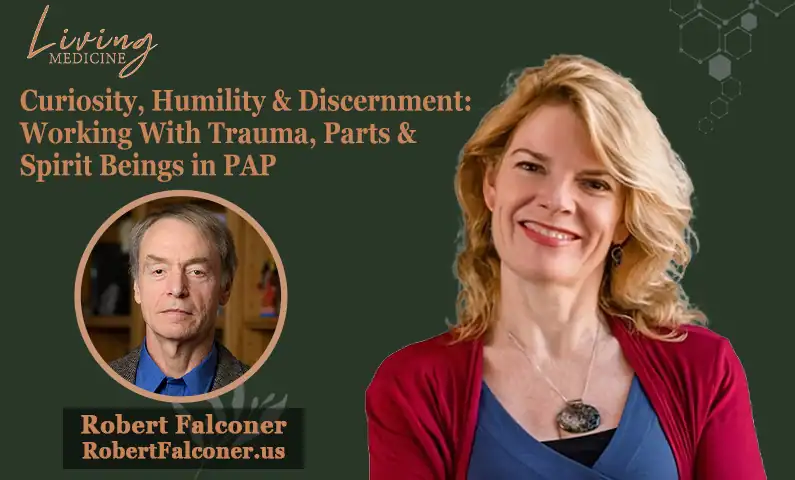
Curiosity, Humility & Discernment: Working With Trauma, Parts & Spirit Beings in PAP

Dr. Sandy Newes

There is a category of clinical experience that most training programs do not prepare you for. A client in the middle of a psychedelic session begins interacting with a presence that seems to have its own agenda, its own voice, its own quality of aliveness. It doesn't feel like a part. It doesn't respond to the usual questions. And you, as the therapist, are sitting there trying to figure out what exactly is happening and what on earth to do about it.
Robert Falconer has been in that room more than almost anyone in the psychedelic therapy world. He is an IFS practitioner, author of the bestselling The Others Within Us: Internal Family Systems, Porous Mind and Spirit Possession, and one of the rare voices in this field who takes unusual inner phenomena seriously — clinically, culturally, and spiritually. His conversation with me was one of the most thought-provoking I've had, and one I've been wanting to bring to this community for a long time.
We Are the Weird Ones
Bob starts from a simple and somewhat radical premise: the Western rejection of spiritual phenomena is not the global norm. It is the exception. Across almost every culture and every era of recorded human history, people have reported meeting conscious beings inside their own minds — beings that do not appear to originate from their personal lifetime history. The metaphor most commonly used across traditions to describe this is spirit possession, a term that carries enormous stigma in the modern West and virtually none in most of the rest of the world.
He quotes William James, who he returns to often: the greatest hindrance to any scientist — the most damaging belief they can hold — is that certain phenomena are impossible. We absorb those beliefs so thoroughly that we stop seeing them as beliefs at all. They become invisible assumptions, baked into the woodwork of our training, our diagnostic categories, our clinical language.
The result, Bob argues, is a kind of enforced blindness that harms people. Not just by failing to help them, but actively — through pathologizing, medicating, hospitalizing, and telling people their brains are broken for having experiences that most of human history would have recognized as meaningful, even sacred.
Roland Griffiths' research gives this some empirical grounding. In large online surveys of people who had encountered what Griffiths called conscious, agentic beings during psychedelic experiences, 80% of those encounters were described as positive. The most common descriptors: wise beings, elder figures, benevolent presences. 20% were difficult or frightening. Our culture's assumption — shaped heavily by Hollywood and by frightened academics — is roughly the inverse of reality.
The Failure of Containers
One of the most useful framings Bob offers is the distinction between the experience itself and the failure to have a container for it. The same inner encounter that, in one cultural setting, would be recognized as a gift — mentored, integrated, given meaning — becomes pathology in ours not because of anything inherent to the experience, but because of the absence of any framework to receive it.
He describes a client, a highly psychic young woman from a small Midwestern town, who could see and hear deceased people as clearly as the living. She didn't dare tell her therapist. She'd been locked up before. There was nothing wrong with her, Bob says, with characteristic directness. She had a gift. But there was something wrong with us.
He contrasts this with what he learned studying with Malidoma Somé from West Africa. In a village where everyone has been initiated — where these kinds of perceptions are recognized as part of the human condition — someone with unusual sensitivity is mentored, not medicated. The experience is normalized. It finds a home. The container exists.
This is what we need to be building, he argues. Not agreement about metaphysics, not a unified theory of what these beings are. A container. A framework that allows unusual experiences to be received with curiosity rather than alarm, explored rather than suppressed, integrated rather than pathologized.
The Pivotal Client
Bob traces his own path into this work to a single client in an IFS Level One training supervision group. She was seeing, in her inner world, what she described as a bloodshot eyeball with legs — something unbelievably critical of her, relentlessly attacking her sense of self.
Bob knew what to do with self-critical parts. You ask what's good about the criticism. You go layer by layer until you find the good intention underneath — the protection, the care, however distorted. He went layer after layer with this thing. There was no good intention anywhere. Not one. Its only aim was to keep her small.
When he asked it directly — are you a part of her? — it dodged, deflected, eventually came out with: No. I'm a much more glorious being, and I'm going to squash you like a worm the same way I'm going to crush her.
For reasons he still can't fully explain, he felt relieved. He finally knew what he was dealing with. They got it out. He closed the group, walked into the staff meeting, and fell apart — body temperature dropping, shaking, uncharacteristically hostile to colleagues. He tried to ignore what had happened.
Then came the email that changed his life. This woman wrote to tell him that since her young adulthood, she had tried to take her life many times, had been institutionalized, had tried to tell people about the nonhuman presence inside her and been given electroshock and heavy medications in return. He was the first person to ever believe her. And he had changed her life.
He followed her for fifteen years. She blossomed. And his career, which he was certain this experience had destroyed, transformed into something he hadn't planned or expected.
The Map: Self, Parts, Legacy Burdens, Unattached Burdens
Bob works within an expanded IFS framework that includes several categories that standard IFS training covers only partially or not at all.
Beyond self and parts, there are legacy burdens — experiences that happened to ancestors and are still reverberating in us. The science here is solid: Rachel Yehuda's work on Holocaust survivors showing altered cortisol chemistry down to the third and fourth generation, and the Dias-Ressler experiment in which male rats were conditioned to fear a specific odor, then their sperm was used to impregnate females who had never been exposed to the conditioning — and the pups showed the same startle response. Something happened to your great-aunt Martha that you never heard about and that could still be echoing in your nervous system, shaping your emotional reactions.
And then there are unattached burdens — what IFS originally called critters, a term Bob clearly prefers. These are not parts. They are not legacy material. They are presences that have attached themselves to a person from outside their own system, often out of their own lostness and desperation.
Bob is careful and precise about the distinction. Parts always have a good intention, however distorted. You drill down far enough and you find the protective impulse underneath. Unattached burdens don't. Keep asking what's good about this, what's the intention, and you'll eventually land on something like: That means I win. Nothing more.
Discernment: How to Tell the Difference
The practical question for clinicians — the one I was most eager to get to — is: how do you actually tell a part from something else, especially in a psychedelic session when things are moving fast and the client's inner world is vivid and strange?
Bob's approach is methodical and surprisingly simple. Ask the presence what its intention is. What does it need? Keep going layer by layer. If it's a part, you will eventually find a good intention underneath the difficulty, however buried. If it's not, you'll hit a dead end — or something that reveals itself as indifferent or hostile to the person's wellbeing.
Then ask it directly: Are you a part of this system? This question itself is diagnostic. Parts tend to answer honestly, often after some resistance. Unattached burdens dodge, deflect, play lawyer. Eventually they tend to reveal themselves.
What comes next is not exorcism. Bob is emphatic about this. More and more, he thinks these presences are lost, suffering, attached to people out of desperation. He approaches them with kindness: You're lost. You're in the wrong place. You can never get what you need here. We're going to help you go somewhere where you can. He compares them to wild animals caught in a trap — dangerous not because they're evil, but because they don't know you're trying to help.
He also always checks with the person's own parts: Is any part of you going to miss this when it's gone? Because often, there is. The unattached burden has been around so long, has become so woven into a person's sense of who they are, that its absence feels unimaginable. His response to those parts: If you were free of this — who would you truly love to be? What would a fulfilling, joy-filled life look like? Have you even had time to dream about that?
These things are always parasites, he notes. The more a part is attached to an unattached burden, the weaker and more tired and more dependent it feels. The more it's connected to self, the stronger and more energized. One small taste of that difference is usually enough to shift everything — because parts aren't stupid.
Trauma, Porousness, and How They Get In
Dick Schwartz has explored brilliantly the fact that mind is multiple. Bob adds the next piece: mind is also porous. We are not fortresses. We resonate. Stuff comes in and stuff goes out. And trauma — especially severe trauma involving domination and violation — can dramatically increase that porousness.
He is direct about something that he finds genuinely disturbing: he believes rape almost literally injects these presences into people. The domination is so profound, the violation of boundaries so total, that something gets in that shouldn't be there. This is one reason why working carefully with survivors of sexual trauma in psychedelic contexts requires particular attention and discernment.
The pattern he describes — something that initially promises power or relief, creates a rush, then slowly increases dependency while the person becomes weaker and more isolated — maps almost exactly onto the structure of addiction. It's the same arc. Something offers what feels like a solution. Over time, more and more of the solution produces less and less of the relief. The person becomes dependent. They can't imagine functioning without it.
What the Therapist's Job Actually Is
Bob's guidance for clinicians sitting with people in psychedelic sessions is simple and, in my experience, hard to actually do. Sit there. Be in self. Be genuinely calm and present. That's it.
The anxious manager part that says I need to be doing something is not helping. When you're in your anxious manager, that's what you're spreading. When you're in self — genuinely centered, genuinely calm — that radiates too. And with psychedelics amplifying everything, it radiates even more powerfully.
If a client encounters a being or a presence during a session, the job is not to intervene or redirect. It's to normalize, to help them stay curious, to support discernment — does this thing have good intentions for you? — and to trust that their inner healing intelligence knows what it's doing.
He is critical of clinicians who impose their own frameworks and dialogues during sessions, who interrupt, who redirect, who essentially impose their own agenda on what is trying to happen. The preparation and integration are where the therapeutic work lives. During the session itself, the job is largely to hold space and get out of the way.
Preparation Means Getting Permission, Not Setting Intention
On preparation, Bob offers something I think is genuinely important and underemphasized: the goal of preparation sessions should not be primarily about setting intention. It should be about getting permission from all the parts.
Making sure every protective part can say, at minimum: Okay. You can do this. We're willing. Because if you go into a session and the medicine blows parts out of the water — which it will very effectively do — those parts will be pissed off, and they will make themselves felt afterward. They will kick your butt. *(his words, and he's right)*
This is one of the most practical pieces of clinical guidance I've received from anyone in this field. Preparation is not about telling the psyche where to go. It's about making sure the whole system is on board for the journey.
What the Next Generation Needs
When I asked Bob what he would change about how we train the next generation of psychedelic-assisted psychotherapists, he had two answers.
First: do your own inner work. That is the foundation. There is no substitute and no shortcut.
Second: humility. Not as a soft value but as a rigorous epistemic commitment. Become the student of your client. Each person is an endless mystery. You will never fully know them. But you can form a relationship with that mystery, and that relationship is where healing lives.
He invokes Socrates and the concept of aporia — not knowing — as the first and most essential stage of wisdom. The oracle at Delphi declared Socrates the wisest man in Greece. He went around sitting with all the people who were supposed to be wise, came back, and said: I know why I'm the wisest. Because I don't know anything. If you can't get to that point — if you can't genuinely value not knowing — you are not open to new experience. You are not open to learning. And in this field, in this work, that closedness will cost you and your clients dearly.
I find myself returning to something Bob said near the end of our conversation: curiosity over certainty. Stay humble. Ask a lot of questions. And then support each other in being better community members.
That seems right to me. And more needed than ever.
With care,
Dr. Sandy Newes
To learn more about Robert Falconer's work:
Website: robertfalconer.us
Book: The Others Within Us
YouTube channel: search Robert Falconer for lectures, demos, and free material
Supervision groups: announced seasonally at his website